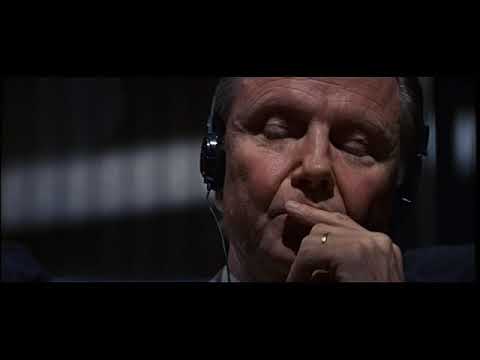
The cows are joined by friend Adam Kane to talk about Tom Cruise’s first outing as Ethan Hunt. We discuss what makes spy movies so appealing and fun, and situate the movie in the broader cultural context of the post-Cold War nineties. We explore the weird and wonderful career of Tom Cruise and how he managed to harness Brian DePalma‘s stylistic flourishes to create one of the tightest, most stressful, spy/heist movies ever.
Emily VanDerWerff (Vox) joins us to discuss Ari Aster’s folk horror masterpiece, Midsommar. We discuss how the film subverts folk horror genre tropes to craft a compelling story about the loss of a relationship, self-discovery, and adoption into a new family. Emily articulates a trans reading of the film, and we discuss how it grapples with the challenge of accommodating our desires for individual autonomy alongside our impulse to find acceptance within a community. Bear suits and Taylor Swift also come up.
The cows revisit True Lies with Van Lathan (The Ringer), discussing how James Cameron inverts the hero’s journey to tell a story about a spy struggling to connect emotionally with his wife and kids while saving the day and causing a lot of mayhem and destruction in the process. Is it the best action comedy of all time? Is it Arnold’s best performance? How does its portrayal of terrorism and American militaristic impunity play today? Tune in to find out!
We crack open a few cold ones (figuratively) with Paul Keelan (Cinematic Underdogs) to unpack and disagree about the Oscar-nominated Another Round. How does the film experiment with existentialism, and how does it explore our complicated relationship with alcohol? Is it worthy of being recognized as among the best films of the year, or is it just Old School dressed up with Kierkegaard quotes? We also react to its portrayal of gendered divisions of labor and explore the film’s attitude towards its characters. We hope you enjoy this unusually critical episode. Let us know what you think about the film!
What is youth? A dream. What is love? The content of the dream.
We head down to the Big Easy with Nicolas Cage scholar Keith Phipps (author of The Age of Cage: Four Decades of Hollywood Through One Singular Career) to discuss Werner Herzog’s hallucinatory tale of a bad cop trying to do the right thing, of addiction in the swamp, of nature’s ever-encroaching wildness into our staid lives. We dive deep into Cage and Herzog both, exploring why they make a perfect pair and how their take on Bad Lieutenant differs so radically from Abel Ferrara’s original. We consider the possibility of absolution in a godless world and whether we can ever really escape our animalistic impulses — two themes that seem to perfectly encapsulate the careers of Cage and Herzog. Listen to the end for a breakdown of various scenes and some recommendations of Cage movies to check out next!
Do you suffer from intergenerational trauma that is manifesting itself in physical malformations on your body and raising red flags for your significant others? Then join us and Jed Shepherd (writer/executive producer of Host) to discuss David Cronenberg’s self-described “more realistic Kramer vs. Kramer,” a film about a couple working through some issues while plagued by demonic children in matching snowsuits. If you haven’t seen the movie, listen to the first 13 minutes for our spoiler free pitch for the movie, and then after you’ve seen it, dive in to talk with us about the nature of body horror and physical media, the terrors of parenthood and why no one in a horror film acts the way you want them to. Along the way, Jed shares his vast knowledge of horror films, and offers up more than a few horrifying recommendations for the unafraid.
Thirty seconds after you’re born you have a past and sixty seconds after that you begin to lie to yourself about it.
The cows take the 405 to Sherman Oaks with friend Andrea Rosen (Fleming Museum of Art) in this revisit of Amy Heckerling’s totally wicked rom-com about modern girl friendship. We discuss the nature of Chers and Karens, how power relations structure what counts as knowledge, and who does and does not count as “clueless.” We revisit our past selves in high school, reflect on the linguistics of Valley Girl speak, and laugh about which characters we were and who of them is most smooch-able. Dance along to No Doubt and the Mighty Mighty Bosstones, but keep an ear out for some surprise appearances by the Insane Clown Posse and Cannibal Corpse!
The cows are joined this week by Dan Harris (Philosophy, Hunter College) on their journey through past lives to uncover and exorcise a few trillion-year-old traumas. We consider how Paul Thomas Anderson depicts a divided soul across three individuals struggling to find order and humanity in a chaotic, animalistic, world, and explore how trauma and masculinity intertwine to forge vulnerabilities, and even love, between two men whose life trajectories seem pointed in opposite directions. We can’t pick just one favorite line, but we do note an homage to Nacho Libre and Anderson’s debts to Kubrick and Huston.
[02:55] Dan’s Introduction to the Master
[09:59] Trauma and war
[22:39] Freddie, Lancaster, and masculinity
[33:26] Divided souls in Freud and Plato
[1:02:32] Cults and demagogues
[1:14:34] The significance of the ending
[1:28:24] Favorite lines
[1:41:08] Outro
[1:43:25] Bass traps are not garbage!
If you already know the answers to your questions then why ask, pig fuck?
We are joined by Kieran Setiya (MIT) to discuss what makes life worth living, what’s lost in an infinite time loop, and to what extent flourishing within such a loop is possible. Along the way, we explore grief, the midlife crisis, atelic actions, the Buddhist concept of Saṃsāra, Kierkegaard, female agency in a world dominated by the male perspective, and the metaphysics of time loops and time travel. Supervenience violations and imaginative resistance are considered, as is Bill Murray’s career arc and also lessons for our current situation during the COVID-19 pandemic.
The cows reverse entropy to discuss Christopher Nolan’s bewilderingly dense sci-fi masterpiece. Part one is a spoiler-free pitch for the movie, while part two explores themes and philosophical issues. Justin argues that the movie is a thematic trilogy with Inception and Interstellar about the evolving nature of parenthood, while Laura makes the case that Kat (Elizabeth Debicki) is the emotional core of the movie. Also covered are: what it is like to interact with time-inverted objects/people, the metaphysics of time and free will, and which confidently delivered obscure line is best. Listen to the end for a recreation of a pivotal scene!
Justin’s diagrams:
Justin’s story about the inverted painting:
You notice something odd in the trash one day. Investigating, you find a number of strips of colored canvas. You pull them out and arrange them on the ground. Suddenly, you feel the urge to destroy the strips. Taking a pair of scissors to the canvas reveals something odd: cutting the strips actually knits them together. Irritated, you cut faster and faster, but the more you cut, the more the canvas connects. One final cut reveals a painting of an old man holding a paintbrush. You marvel at what has happened, but you’re even more intrigued by the painting itself — it’s familiar somehow, so you decide, rather than destroy it, you’ll frame it and put it on the wall. As the years go by, and the painting becomes part of your daily life, the itch to paint grows in you, so you take painting lessons. One day, there’s a knock at the door and someone has left you a box. Inside is a paintbrush and easel unlike any you’ve encountered. When you pick them up, they remind you of the canvas you found so many years ago in your trash. As you bring the paintbrush towards the canvas, you notice for the first time that the paint on the canvas is wet. You bring the brush to dry it, but as you do, the paint rubs off on the brush. Again and again, brush stroke after brush stroke, you paint the paint off the canvas. Eventually, you’re left with a blank canvas, and finally, glancing in the mirror, you realize who it was all along. There’s a knock at the door, and you know what must be done — you put the paintbrush and easel back in the box and hand it to the man at the door, who, without speaking, walks backwards down the street and out of sight.
Don’t get on the chopper if you can’t stop thinking in linear terms.